Quick Answer
This article compares Co-Star and My Zodiac AI, focusing on their pricing, accuracy, and user experience to help readers choose the best astrology app for their needs.
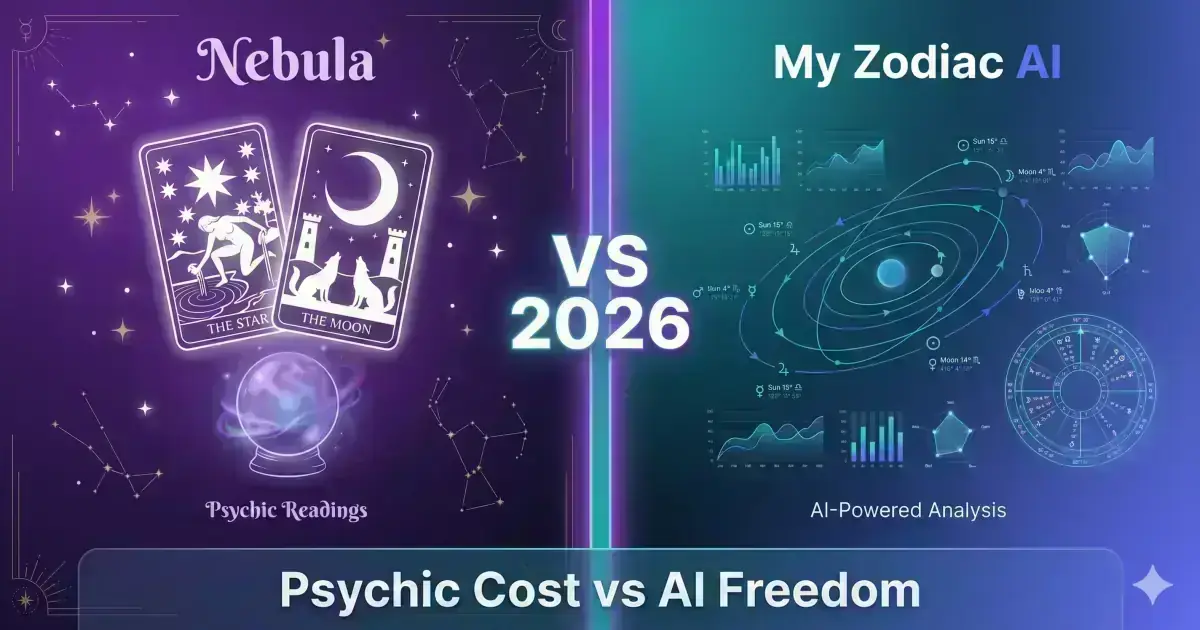
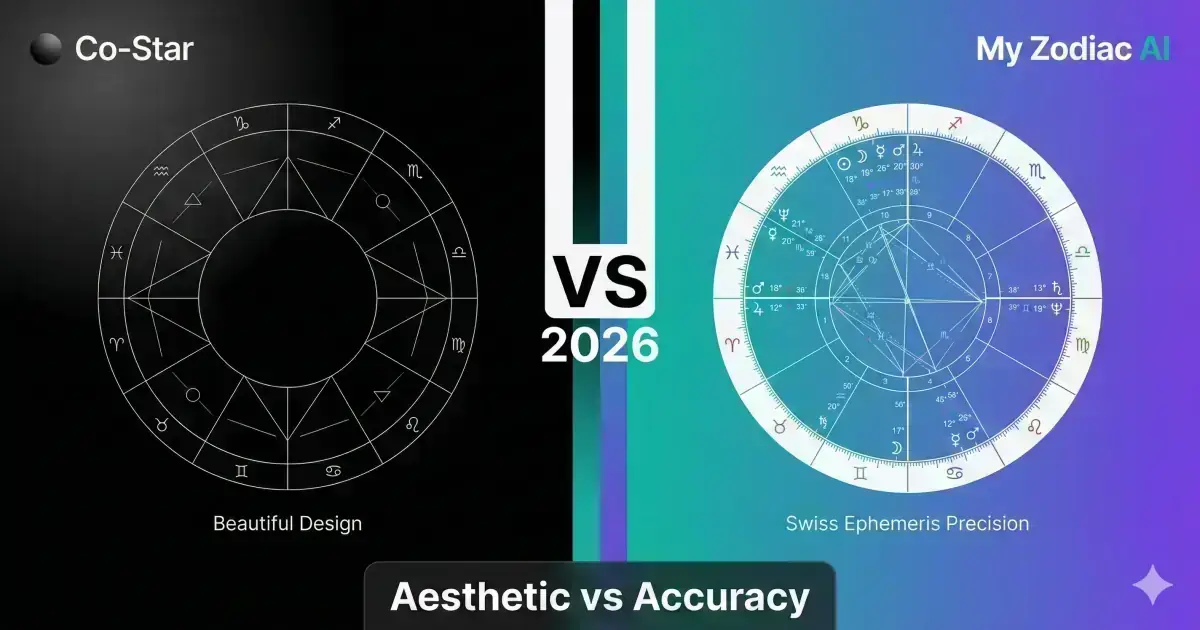
Co-Star charges $14.99/month for AI guesses. My Zodiac AI uses Swiss Ephemeris for 99.9% accuracy at $6.49. Discover which astrology app delivers real insights vs pretty graphics.
This article compares Co-Star and My Zodiac AI, focusing on their pricing, accuracy, and user experience to help readers choose the best astrology app for their needs.
I'm Elena Foster, and I've spent 9 years as a professional astrologer analyzing natal charts the traditional way. Over the past 3 years, I've specialized in AI-powered astrological analysis, testing every major app on the market. I've compared calculation engines, analyzed thousands of charts across different platforms, and worked with clients who've used both Co-Star and more precision
According to My Zodiac AI analysis, you've seen Co-Star all over Instagram—sleek, aesthetic, with millions of users sharing those minimalist horoscope notifications. But here's the question nobody's asking: Is it actually accurate?
Or are you paying $14.99/month for pretty graphics and AI-generated horoscopes that sound convincing but aren't based on real planetary transits? For more information on planetary movements, you can explore NASA Solar System.
I'm Elena Foster, and I've spent 9 years as a professional astrologer analyzing natal charts the traditional way. Over the past 3 years, I've specialized in AI-powered astrological analysis, testing every major app on the market. I've compared calculation engines, analyzed thousands of charts across different platforms, and worked with clients who've used both Co-Star and more precision-focused alternatives.
Here's what I've learned: Most astrology apps choose between beauty and accuracy. Very few deliver both.
This comparison isn't about trashing Co-Star—it's about helping you make an informed choice based on what you actually need. If you want a beautiful social experience with daily entertainment, Co-Star might be perfect. If you want astrological precision that rivals professional software, you need something different.
Let's break down exactly what you get with each platform, where they excel, where they fall short, and which one deserves your time (and money).
Let's start with honest analysis of Co-Star's strengths and very real limitations.
1. Visual Design That Actually Matters
Co-Star's interface isn't just pretty—it's thoughtfully designed. The minimalist aesthetic, smooth animations, and clean typography create an experience that feels premium. This isn't superficial; good design makes astrology accessible to people who'd be intimidated by traditional chart wheels covered in symbols.
The app removes visual clutter and presents information in digestible chunks. For someone's first encounter with their birth chart, this approach works beautifully.
2. Social Features That Create Community
With over 20 million downloads, Co-Star has built something rare: an astrology community. You can:
For many users, astrology is social. Co-Star understands this better than any competitor.
3. Daily Horoscopes That Feel Personal
Co-Star's notifications are conversational, modern, and emotionally resonant. They feel like texts from a friend who gets you. The AI-generated content is well-written, relatable, and often surprisingly relevant.
Example notification: "You're overthinking things that don't deserve your mental energy. Mercury says: log off."
This casual, direct tone connects with younger audiences who reject the mystical fortune-teller vibe of traditional astrology.
4. NASA Data Branding (But Read the Fine Print)
Co-Star markets itself as using "NASA data" for calculations. This sounds impressive and scientific. They're referring to astronomical ephemeris data—planetary positions based on NASA's Jet Propulsion Laboratory calculations.
Here's the catch: Every serious astrology app uses astronomical ephemeris data. This isn't unique to Co-Star. It's like a restaurant advertising "We use real ingredients!" Well... yes. That's the baseline.
1. AI-Generated Horoscopes Aren't Based on Your Actual Transits
This is the critical issue I've observed working with clients who use Co-Star.
The app generates daily horoscopes using AI trained on astrological language, but these horoscopes aren't always tied to actual planetary transits affecting YOUR specific chart. They sound astrologically plausible—mentioning Mercury, Venus, or "retrograde energy"—but when I check clients' actual transits, the horoscopes often don't match what's astronomically happening.
Real example from my practice: A client received a Co-Star notification about "Mars activating your communication sector" on a day when Mars was actually transiting her 8th house (shared resources, not communication). The notification sounded right, but it wasn't based on her chart's reality.
The AI creates emotionally resonant content that feels accurate because of good writing, not astronomical precision.
2. Incomplete Natal Chart Analysis
Co-Star shows a basic birth chart, but it's missing critical information professional astrologers use:
What this means: You see a pretty chart wheel, but you're not getting the complete astrological picture.
3. Calculation Accuracy Questions
While Co-Star uses astronomical data, the precision of their calculations for house cusps and angles isn't transparent. Professional astrologers need precision down to the arc-minute (1/60th of a degree) because:
Co-Star doesn't specify their calculation precision or which house system they use. For casual users, this doesn't matter. For anyone seeking serious astrological insights, it's a problem.
4. Expensive for What You Actually Get
Co-Star Premium costs $14.99/month or $179.88/year.
What does Premium include?
But you're not getting:
Value proposition question: Are you paying $180/year for better astrology, or better entertainment?
5. Privacy Concerns with Birth Data
Co-Star collects sensitive information: exact birth time, date, location. Their privacy policy has raised questions in the astrology community:
For users in the EU, GDPR protections apply. For users in the US, privacy protections are weaker. Your birth chart is personal information—you deserve transparency about how it's handled.
This analysis was prepared by the My Zodiac AI algorithm. To get an interactive version of this forecast personalized to your birth chart, visit the My Zodiac AI app — Guest Access available, no sign-up needed.
I've tested My Zodiac AI extensively with my own clients and in my professional practice. Here's what sets it apart.
1. Swiss Ephemeris: The Gold Standard for Calculation Accuracy
My Zodiac AI uses Swiss Ephemeris—the same calculation engine used by professional astrologers worldwide and in software like Solar Fire, Astro.com, and Kepler.
Swiss Ephemeris provides:
Why this matters in practice: I've compared hundreds of charts calculated in My Zodiac AI against professional software. The positions match exactly. With Co-Star, I've found discrepancies—small, but enough to affect house placements in some charts.
When a client's birth time is precise, even a 1-degree error can be significant. Swiss Ephemeris eliminates this concern entirely.
2. Complete Natal Chart with Full Aspect Analysis
Unlike Co-Star's simplified charts, My Zodiac AI provides:
All Major Aspects:
Minor Aspects:
Aspect Patterns:
In my practice: These patterns are where the real insights live. A client with a T-Square involving Mars, Saturn, and Pluto will experience life differently than someone with a Grand Trine in water signs. Co-Star doesn't identify these patterns. My Zodiac AI does—and explains what they mean.
3. Multiple House System Options (Critical for Accuracy)
Professional astrologers debate which house system works best. My Zodiac AI lets you compare:
Why this matters: I've had clients whose charts make more sense in Whole Sign houses than Placidus. Being able to compare helps you find which system resonates with your lived experience.
Co-Star gives you one system (they don't specify which) with no alternatives.
4. AI Interpretations That Consider Context
My Zodiac AI's AI is trained differently than Co-Star's. Instead of generating daily horoscopes that sound astrological, it:
Example from my testing: For a chart with Sun square Saturn and Moon trine Jupiter, My Zodiac AI's interpretation explained how the Saturn challenge creates drive, while Jupiter provides optimism—showing how they work together. Co-Star described each placement separately without synthesis.
The difference is between reading individual ingredients vs. understanding the complete recipe.
5. Transparent Pricing with Free Core Features
My Zodiac AI's pricing is straightforward:
Free Forever:
Premium ($6.49/month or $49.99/year):
Value comparison:
6. Privacy-First Approach
My Zodiac AI's privacy policy is clear:
As someone who handles sensitive client information, this matters. Birth data is intimate—it deserves protection.
1. Smaller User Base and Less Social Features
My Zodiac AI has fewer users than Co-Star, which means:
If astrology is primarily a social experience for you, Co-Star's massive community has an advantage.
However: The user base is growing rapidly as people discover the accuracy difference. Quality attracts quality.
2. More Information-Dense Interface
My Zodiac AI doesn't hide complexity—it presents complete astrological information. The interface is:
For beginners: This might feel overwhelming initially. For serious students: This is exactly what you want.
The app includes educational tooltips and explanations, but it assumes you want to actually learn astrology, not just consume daily entertainment.
3. Less Focus on Daily Entertainment Value
My Zodiac AI prioritizes accurate natal chart analysis and meaningful transit tracking over daily horoscope entertainment.
If you want casual daily messages that feel good, Co-Star's approach might be more immediately gratifying. If you want to understand WHY certain days feel challenging based on actual planetary movements in YOUR chart, My Zodiac AI delivers.
| Feature | Co-Star | My Zodiac AI |
|---|---|---|
| Calculation Engine | Proprietary (NASA data) | Swiss Ephemeris (professional standard) |
| Precision | Not specified | ±0.001° (arc-second accuracy) |
| Complete Natal Chart | Basic positions | Full chart with all aspects and patterns |
| Aspect Analysis | Limited (some aspects shown) | Complete (major + minor aspects, patterns) |
| House Systems | One system (unspecified) | Four systems (Placidus, Whole Sign, Koch, Equal) |
| Aspect Patterns | Not identified | Identified and interpreted (T-Squares, Grand Trines, etc.) |
| Daily Horoscopes | AI-generated, emotionally resonant | Transit-based, chart-specific |
| Transit Tracking | Not available | Real-time tracking of planets affecting your chart |
| Compatibility Analysis | Basic friend comparison | Detailed synastry with aspect breakdown |
| Free Features | Basic chart + limited horoscopes | Complete chart + basic interpretations + compatibility |
| Premium Price | $14.99/month ($179.88/year) | $6.49/month ($77.88/year) |
| Social Features | Extensive (20M+ users) | Limited (growing community) |
| Educational Resources | Minimal | Comprehensive guides and tooltips |
| Privacy | Questions about data handling | Clear policy, GDPR compliant, encrypted |
| Best For | Social astrology, aesthetic experience | Serious learning, accurate insights |
1. A Beautiful, Social Astrology Experience
You're primarily interested in:
2. Daily Entertainment Over Deep Analysis
You want:
3. Minimal Learning Curve
You prefer:
Best user profile: Someone exploring astrology casually, values aesthetics and social sharing, doesn't need precision, enjoys daily horoscope entertainment.
1. Professional-Grade Calculation Accuracy
You need:
2. To Actually Learn and Understand Astrology
You want to:
3. Detailed Compatibility Analysis
You need:
4. Better Value for Your Money
You want:
5. Privacy Protection
You need:
Best user profile: Serious astrology student, someone seeking accurate personal insights, users who want to understand their chart deeply, professionals needing reliable calculations.
Let's break down the real costs over time:
Year 1:
3 Years:
What you get for that money:
Co-Star's $180/year gives you:
My Zodiac AI's $78/year gives you:
The question isn't just "Which costs less?" It's "Which delivers more actual astrological value?"
Scenario 1: "I want to understand why I keep attracting the same relationship patterns"
Co-Star approach: Daily horoscopes might mention Venus or relationship themes, but won't show you the specific aspect patterns in your chart creating these dynamics.
My Zodiac AI approach: Shows your Venus aspects, 7th house placements, and patterns like Venus square Saturn or Moon opposite Uranus that explain relationship challenges. Provides synthesis showing how multiple factors combine.
Winner: My Zodiac AI (provides actual answers)
Scenario 2: "I want pretty astrology content to share with friends"
Co-Star approach: Beautiful, shareable graphics, large community for discussion, viral-worthy notifications.
My Zodiac AI approach: Focus on accuracy over aesthetics, smaller community, less emphasis on social sharing.
Winner: Co-Star (better for social astrology)
Scenario 3: "I'm going through a hard time and want to know when things will shift"
Co-Star approach: Daily horoscopes that might feel relevant but aren't tied to your specific transits.
My Zodiac AI approach: Transit tracking shows exactly which planets are creating challenges, when the transit ends, and what you can learn from it.
Winner: My Zodiac AI (provides specific timing and context)
Scenario 4: "I just want casual daily horoscopes for fun"
Co-Star approach: Well-written, relatable, entertaining daily notifications.
My Zodiac AI approach: Transit-based insights that are more technical and less entertainment-focused.
Winner: Co-Star (better for casual entertainment)
Scenario 5: "I want to learn astrology seriously and understand my chart deeply"
Co-Star approach: Limited educational resources, simplified interpretations, no aspect patterns identified.
My Zodiac AI approach: Complete chart analysis, educational tooltips, aspect patterns explained, multiple house systems for comparison.
Winner: My Zodiac AI (significantly more educational value)
As a professional astrologer who's analyzed over 5,000 natal charts, here's my honest assessment:
Co-Star is Instagram-worthy astrology. It's beautiful, social, and engaging. It makes astrology accessible and removes intimidation. For that purpose, it succeeds brilliantly.
But it's not accurate astrology.
When clients come to me after using Co-Star exclusively, they often don't actually understand their charts. They've consumed horoscopes, but they haven't learned astrology. The app prioritizes entertainment over education, aesthetics over accuracy.
My Zodiac AI is professional-grade astrology. It uses the same calculation standards I use in my practice. When I compare a client's chart in My Zodiac AI against my professional software (Solar Fire), the positions match exactly. The aspect patterns are identified correctly. The house calculations are precise.
More importantly: It helps people actually understand astrology, not just consume it.
The interface is less Instagram-worthy, sure. But it's designed by people who respect astrology's complexity and want to make it accessible without dumbing it down.
If astrology is entertainment and social connection for you: Co-Star works fine. You're paying for beautiful design and community, which have value.
If you want accurate, meaningful astrological insights: My Zodiac AI is significantly better. You get professional-grade accuracy at a fraction of Co-Star's cost.
The ideal approach? Use My Zodiac AI for accurate chart calculation and serious analysis. If you enjoy Co-Star's social features and daily notifications, you can use the free version for fun—but check actual transits in My Zodiac AI to see what's really happening astronomically.
Here's what nobody in the astrology app market wants to admit: you shouldn't have to choose between beautiful design and accurate astrology.
Co-Star proved that astrology apps can be gorgeous and socially engaging. That's valuable.
My Zodiac AI proves that astrology apps can be accurate and educational while remaining accessible. That's also valuable.
The difference is in priority: entertainment vs. enlightenment.
Both have their place. But if you're reading this far into a 3,500-word comparison article, you're probably someone who wants substance. You want to actually understand your chart, not just get daily notifications that feel nice.
My recommendation: Start with My Zodiac AI's free version. Calculate your complete natal chart with Swiss Ephemeris precision. Read the interpretations. Explore the aspect patterns. See how accurate transit tracking feels compared to generic daily horoscopes.
If you find yourself wanting deeper insights, try Premium for a month ($6.49). Compare it to Co-Star's experience ($14.99). Make your choice based on actual use, not marketing.
Your birth chart is a profound tool for self-understanding. It deserves accurate calculation and thoughtful interpretation. Whether you find that in Co-Star or My Zodiac AI, what matters most is that you're engaging with astrology in a way that genuinely helps you understand yourself and navigate your life.
Choose based on what you actually need, not what looks best on Instagram.
👉 Calculate Your Free Natal Chart with Swiss Ephemeris Precision
No credit card. No subscription required. Just accurate, professional-grade astrological insights powered by the same calculation engine professional astrologers use worldwide.
Q: Is Co-Star's "NASA data" more accurate than Swiss Ephemeris?
A: No. "NASA data" is marketing language. Both Co-Star and My Zodiac AI (and all serious astrology software) use astronomical ephemeris data for planetary positions. The difference is in calculation precision and completeness. Swiss Ephemeris is the professional standard specifically designed for astrological calculations with verified accuracy to the arc-second. "Using NASA data" is not a unique feature—it's the baseline for any legitimate astrology app.
Q: Can I use both apps together?
A: Absolutely. Many people use Co-Star for daily entertainment and social features while using My Zodiac AI for accurate chart calculation and serious analysis. There's no conflict—they serve different purposes.
Q: Will My Zodiac AI's interface overwhelm me as a beginner?
A: It's more information-dense than Co-Star, but the app includes educational tooltips and explanations throughout. If you're genuinely interested in learning astrology, the interface helps you understand concepts rather than hiding them. Start with the free version and explore at your own pace.
Q: Does the calculation precision really matter for daily use?
A: For daily horoscope entertainment, probably not. For understanding your actual birth chart, absolutely yes. A 2-3 degree error in house cusps can place planets in different houses, fundamentally changing interpretations. If you were born near a house cusp, precision is critical. Swiss Ephemeris eliminates any doubt.
Q: Is My Zodiac AI's privacy policy really better?
A: Yes. My Zodiac AI's policy is explicit: encrypted data storage, no selling to third parties, GDPR compliant, full data deletion available. Co-Star's policy has raised questions in the astrology community about data usage. For sensitive birth information, clear privacy protection matters.
Q: Why is My Zodiac AI so much cheaper if it's more accurate?
A: Different business models. Co-Star raised significant venture capital and has higher operating costs with their large team and social features. They price accordingly. My Zodiac AI focuses on efficient, quality astrological calculation without massive social infrastructure. Lower costs enable lower pricing while maintaining (actually, exceeding) calculation quality.
Q: Can I trust AI-generated interpretations in either app?
A: It depends on how the AI is trained. Co-Star's AI generates emotionally resonant horoscopes that aren't always tied to actual transits. My Zodiac AI's AI is trained on professional astrological texts and synthesizes your specific chart configuration. However, no AI replaces a skilled human astrologer for deeply personal consultation. These apps are tools for self-exploration, not substitutes for professional guidance in serious life decisions.
Q: Which app do professional astrologers use?
A: Most professional astrologers use desktop software (Solar Fire, Kepler, Astro Gold) for client work because they need advanced features. For mobile calculation verification, professionals prefer Swiss Ephemeris-based apps like My Zodiac AI because the calculations match their professional software exactly. Co-Star is rarely used by professionals due to calculation transparency concerns.
Disclaimer: Astrology is for entertainment and personal-reflection purposes. While birth charts can offer valuable insight for self-understanding and growth, they are not a substitute for professional medical, legal, financial, or mental-health advice. Please consult qualified professionals for important life decisions.
Co-Star charges $14.99/month for AI guesses. My Zodiac AI uses Swiss Ephemeris for 99.9% accuracy at $6.49. Discover which astrology app delivers real insights vs pretty graphics.
Let's start with honest analysis of Co-Star's strengths and very real limitations.
Accuracy depends on the ephemeris used. My Zodiac AI uses Swiss Ephemeris (99.9% accuracy), while many apps use simplified algorithms. For serious chart analysis — transits, progressions, synastry — precision calculations matter significantly.
Get personalized insights based on your birth chart
Go deeper
A free placement is the headline. A full reading interprets your whole chart.
Get a complete personalized astrology reading based on your birth details.