Eclipses involve the alignment of the Sun, Earth and Moon. The lunar nodes help describe the orbital geometry; they do not turn an eclipse into a personal destiny accelerator. This guide corrects the event calendar and distinguishes astronomical facts, astrological interpretation and viewing safety.
The Moon’s orbital plane intersects the ecliptic at the ascending and descending nodes. The paired points are opposite using the same convention. They are mathematical references, not planets. Astrodienst’s Moon’s Nodes reference explains the geometry and separately describes astrological meanings.
NASA’s eclipse overview distinguishes solar eclipses at new moon from lunar eclipses at full moon. Eclipses require the relevant alignment; a new or full moon alone does not establish that an eclipse occurs. The relationship to the nodes concerns geometry, not an evidence-based multiplier of emotional or karmic intensity.
The earlier article’s “10x” amplification, destiny downloads and compulsory identity changes had no verified basis. A Sun-sign label or a chart aspect does not establish those personal results.
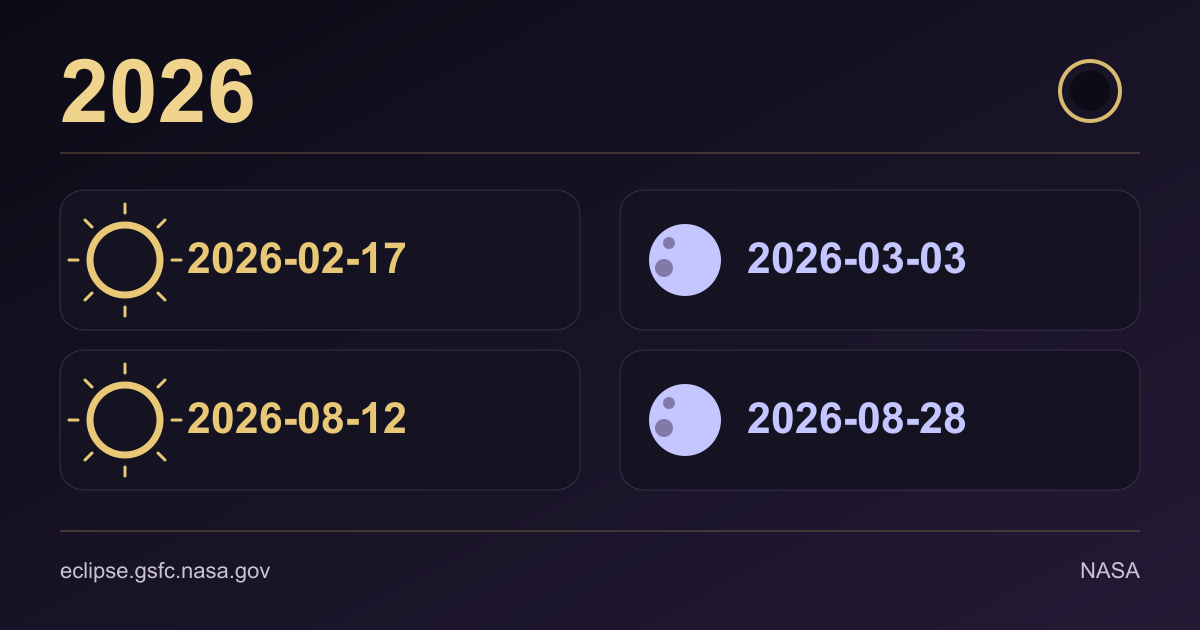
The NASA solar catalog and NASA lunar catalog list the following events. Dates are the catalogs’ dates of greatest eclipse; their clock column uses Terrestrial Dynamical Time (TD), not a local clock or an invented UTC conversion.
| Catalog date | Eclipse type |
|---|
| 2026 February 17 | Annular solar |
| 2026 March 3 | Total lunar |
| 2026 August 12 | Total solar |
| 2026 August 28 | Partial lunar |
| 2027 February 6 | Annular solar |
| 2027 February 20 | Penumbral lunar |
| 2027 July 18 | Penumbral lunar |
| 2027 August 2 | Total solar |
| 2027 August 17 | Penumbral lunar |
February 17, 2027 was not the correct solar-eclipse date. August 27, 2026 and February 21, 2027 are not the respective catalog dates, though local nights can fall on those dates in some time zones. A date should name its reference basis. The table does not describe visibility from every location or provide local observing times.
The August 12, 2026 event is classified as a total solar eclipse, not globally a partial event. The August 28 lunar event is partial, not penumbral. What a solar observer sees depends on location. This distinction matters for safety as well as accurate reporting.
A tropical Aquarius–Leo node axis does not by itself determine the Sun or Moon’s tropical longitude at an eclipse. The earlier Aquarius 4° and Leo 12° lunar labels were unsupported; NASA’s calendar is not a source of Western zodiac degrees.
An exact eclipse-degree claim requires a separately documented calculation at an identified event time and time scale. This article supplies no fabricated degrees, start/end clocks or worldwide observing window. It also does not classify physical eclipses as online events organized by My Zodiac AI.
The Swiss Ephemeris manual describes true and mean node conventions. The 2026 tropical daily table brackets the true North Node’s boundary toward Aquarius in late July and the mean-node boundary on August 18–19. The 2028 table places the next boundaries toward Capricorn in March.
The tables use rounded daily positions at 00:00 UT. They do not establish an exact ingress minute or exclude crossings between samples. The earlier January 2028 endpoint was unsupported. A convention-specific node date and an astronomical eclipse date are different information; neither validates a personal forecast.
Follow NASA’s viewing guidance. Ordinary sunglasses are unsafe. Eclipse glasses do not make unfiltered cameras, binoculars or telescopes safe; suitable solar filters belong at the Sun-facing front. Unprotected direct viewing is limited to complete totality inside its path, never partial or annular phases.
A symbolic ritual is not eye protection. If you want to observe, check the actual event, your location and current expert instructions. You can read about an eclipse without watching the Sun.
If an eclipse is a useful reminder to review a plan, choose an actual question: what information is missing, whose consent is needed, or which commitment remains reasonable? You can ask that question on any day. There is no requirement to make a major decision during an eclipse season.
A relationship ending, an unexpected expense or a difficult feeling is not proof that a node is forcing a lesson. Do not delay appropriate care or support while waiting for a supposedly favourable date. Astrological symbolism cannot diagnose hidden trauma, establish financial suitability or tell you another person’s intentions.
For sign-level topics, use the corrected all-sign guide. It labels solar overlays rather than assigning natal houses to every Sun sign. The North Node guide separates a transit from a natal placement. If exploring the birth-chart calculator, keep uncertain inputs and the Ascendant convention visible.
AI-assisted editorial content. Astrological interpretation is optional reflection, not a verified fate, diagnosis or professional advice.