The lunar nodes are calculated reference points. In 2026, their tropical Aquarius–Leo positions supply an astrological theme, not a schedule of changes that every zodiac sign will experience. This guide separates orbital geometry, calculation settings and optional interpretation, then links to the corrected sign guides.
The Moon’s orbital plane intersects the ecliptic at two nodes. The ascending or North Node and descending or South Node form opposite ends of an axis. They are not planets. A paired north and south position uses the same calculation convention; an Aquarius North Node corresponds to a Leo South Node.
Astrodienst’s Moon’s Nodes reference distinguishes astronomy from the meanings assigned in astrology. Past-life mastery, soul purpose and compulsory personal growth are interpretations. The geometry does not verify those stories about a reader.
A chart can use a true node or a mean node, and a tropical or sidereal zodiac. These are separate settings. The mean node smooths the motion; the conventional true node can temporarily move direct. The Swiss Ephemeris technical manual describes both methods and their limits.
The official 2026 daily ephemeris uses a tropical geocentric zodiac and entries at 00:00 UT. Its rounded positions bracket the true North Node’s Pisces-to-Aquarius boundary in late July, while the mean-node boundary is between August 18 and 19. These daily rows do not supply an exact ingress minute or exclude a crossing between samples.
The 2028 ephemeris places the next Aquarius-to-Capricorn boundaries in March: the mean-node daily bracket is March 7–8, and the true-node bracket March 26–27. The earlier January 2028 endpoint was unsupported. This guide does not assert an exactly timed, uninterrupted true-node residence throughout the interval or convert UT into a local clock.
If two calendars disagree, check their node convention and zodiac before treating either result as wrong. A precise-looking value is not a certification of a particular app or a validation of its interpretation.
A simplified solar-sign overlay treats the reader’s Sun sign as its first position. It is a convention for arranging topics. An actual natal chart requires a date, usable time reference, location and stated house system. In Whole Sign houses, the first house is the sign containing the Ascendant, which need not be the Sun’s sign.
The table below counts Aquarius and Leo from each Sun sign. It does not say that the nodes occupy those natal houses for every reader, nor that a topic will become an event. The questions are examples that you may adapt or ignore.
These questions do not rank signs by sensitivity or importance. A Sun sign cannot tell us who will experience a career change, relationship change or health concern. Look at what actually happens and what choices are available, rather than treating a stereotype as a diagnosis.
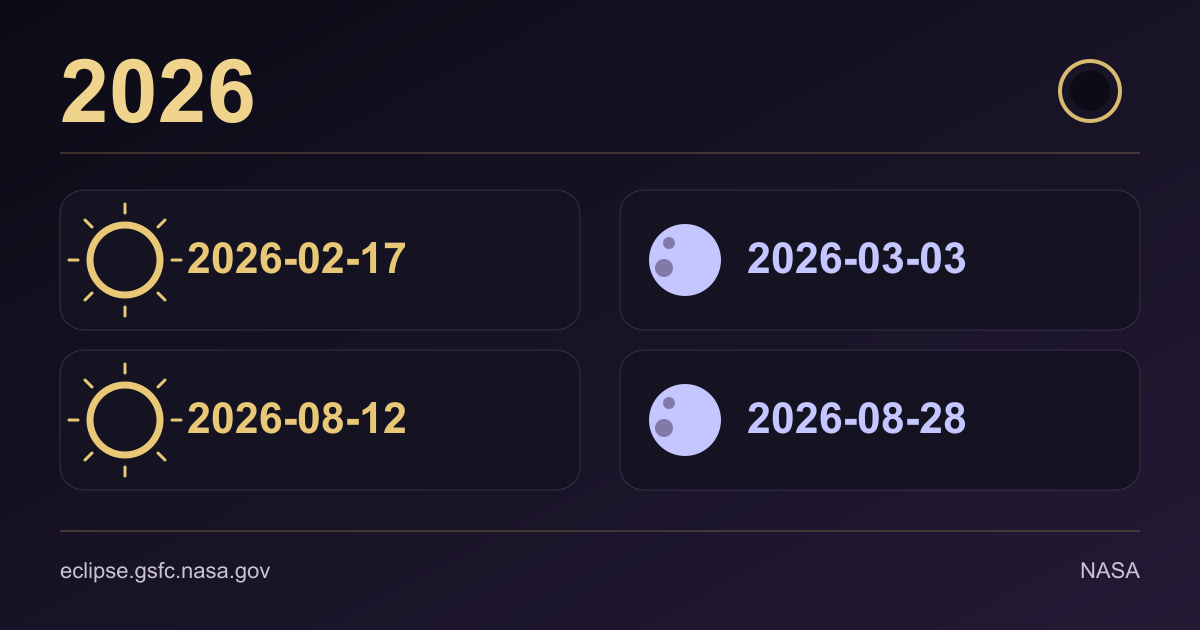
NASA’s complete decade catalogs list four eclipses in 2026: solar events on February 17 and August 12, and lunar events on March 3 and August 28. In 2027, the solar dates are February 6 and August 2; the lunar dates are February 20, July 18 and August 17. Sources: solar catalog and lunar catalog.
These are catalog dates of greatest eclipse. The catalog clock basis is Terrestrial Dynamical Time (TD); local calendar dates can differ. February 17, 2027 was an incorrect solar date in the earlier article. An August 27 local night can correspond to the August 28 catalog event, so a correction must name its date basis.
The sign of the node does not establish the tropical Sun or Moon sign, degree or visibility of an eclipse. This guide gives no unsupported eclipse degree, local clock or personal activation timeline. For observation, follow NASA’s eclipse safety guidance, rather than treating a reflective exercise as viewing instructions.
A natal node and a currently transiting node are different references. An astrologer may compare them with other positions using degrees, aspects and an orb convention. Having a planet somewhere in Aquarius or Leo is not enough to establish an exact conjunction. A calculated comparison also does not verify a past life or guarantee a future result.
The birth-chart calculator can be explored with the limits of your inputs in view. The corrected Ascendant definition explains why uncertain time should remain visible. For the difference between a chart and its interpretation, see the natal-chart definition.
If a symbolic topic is useful, turn it into a question about a real situation. Check facts, ask other people directly and respect consent and practical constraints. You do not need to donate money, join a group, leave a relationship or take on a helping role to complete a cosmic assignment. Medical, financial, legal and mental-health matters require appropriate real-world information and support.
AI-assisted editorial content. Astrology symbolism is optional reflection, not a verified destiny, diagnosis or professional advice.