Quick Answer
Secondary progressions in astrology advance your natal chart symbolically, revealing internal growth and personal development over time, contrasting with transits that indicate external events.
Learn how secondary progressions work in astrology using the day-for-a-year method, what they reveal about inner growth, and how they differ from transits.

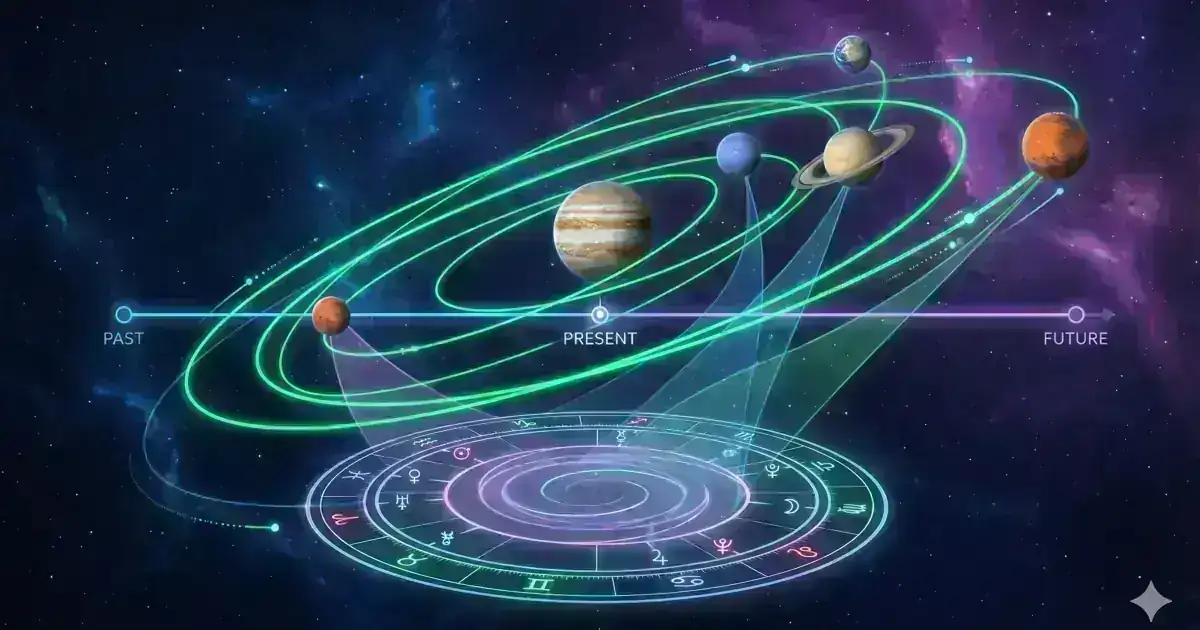
Secondary progressions in astrology advance your natal chart symbolically, revealing internal growth and personal development over time, contrasting with transits that indicate external events.
Secondary progressions are a predictive technique that takes your natal chart — the snapshot of the sky at the moment you were born — and advances it symbolically over the course of your life fact:8a3279e4-2cce-5358-a057-ed7df9791d59 . The method rests on a simple, elegant correspondence: one day after birth equals one year of life fact:8463bb0f-c4ed-51a2-a205
Secondary progressions are a predictive technique that takes your natal chart — the snapshot of the sky at the moment you were born — and advances it symbolically over the course of your life fact:8a3279e4-2cce-5358-a057-ed7df9791d59. The method rests on a simple, elegant correspondence: one day after birth equals one year of life fact:8463bb0f-c4ed-51a2-a205-0392b0ea246c. So the planetary positions on the day following your birth describe your first year, the positions on the next day describe the year after that, and so on as you age fact:6236d3f2-dcd9-5071-936b-24911ee4d728. This is why progressions are sometimes called the "day-for-a-year" system fact:8a3279e4-2cce-5358-a057-ed7df9791d59.
What makes this technique distinctive within predictive astrology is what it actually tracks. Rather than showing external events and opportunities, secondary progressions reveal internal evolution and personal development — how you grow and change from the inside out fact:27da7ab8-690d-54d4-9153-e28b5b9f88a4. They illuminate your evolving personality, your shifting needs and priorities, and the developmental cycles you move through over a lifetime fact:c4a38c1b-af4f-5a30-b9d0-fd5e99e983f9.
This is the crucial distinction between progressions and transits. Transits show the current, real-time positions of planets in the sky affecting your chart right now — the external "cosmic weather" of opportunities and challenges fact:27da7ab8-690d-54d4-9153-e28b5b9f88a4. Progressions, by contrast, show how your chart itself evolves internally fact:8a3279e4-2cce-5358-a057-ed7df9791d59. Where transits point outward to events and timing, progressions point inward to psychological unfolding, which is why the two are considered complementary in any complete chart reading fact:8463bb0f-c4ed-51a2-a205-0392b0ea246c. In short, transits show external triggers; progressions show internal evolution fact:27da7ab8-690d-54d4-9153-e28b5b9f88a4.
Solar arc directions are another predictive method in the astrologer's toolkit, but they should not be confused with secondary progressions fact:cadb6088-b0eb-510f-8415-24a4f7cf5402. In solar arc, every point in the chart is advanced by the same amount — the distance the Sun has moved by progression — so all planets and angles shift together, whereas secondary progressions let each planet move at its own natural speed fact:cadb6088-b0eb-510f-8415-24a4f7cf5402. The two techniques use different mathematics and produce different chart movements, even though both belong to the broader family of directed or advanced-chart methods that astrologers use alongside transits to build a fuller picture of timing fact:6236d3f2-dcd9-5071-936b-24911ee4d728.
For beginners, the simplest way to anchor the concept is this: your natal chart is your cosmic blueprint at birth, while your progressed chart reveals how you evolve over time fact:2cf213ff-f3ad-5658-bb70-b61b970290af. Progressions show your life not as something static, but as an ongoing process of evolution and development fact:8a3279e4-2cce-5358-a057-ed7df9791d59.
At the heart of secondary progressions lies a deceptively simple equation: one day after birth equals one year of life fact:8463bb0f-c4ed-51a2-a205-0392b0ea246c. This day-for-a-year formula advances your natal chart symbolically rather than literally fact:8463bb0f-c4ed-51a2-a205-0392b0ea246c. Where transits track the planets as they actually move through the sky today, progressions treat each successive day following your birth as a stand-in for a successive year of living fact:8a3279e4-2cce-5358-a057-ed7df9791d59.
To see how the age calculation works in practice, the counting is direct: the day after birth corresponds to the first year of life, the next day to the second year, and the pattern continues from there fact:6236d3f2-dcd9-5071-936b-24911ee4d728. Put another way, the planetary positions recorded shortly after you were born become the symbolic snapshot of your inner life many years on fact:c4a38c1b-af4f-5a30-b9d0-fd5e99e983f9. This is why progressions describe internal psychological evolution rather than external events — the chart itself is unfolding from within fact:c4a38c1b-af4f-5a30-b9d0-fd5e99e983f9.
The mechanics rely on an ephemeris, the reference table of planetary positions for each day fact:6236d3f2-dcd9-5071-936b-24911ee4d728. Because the formula maps days onto years, an astrologer simply reads forward in the ephemeris from the birth date, counting one day for each year of age, to find where the progressed planets have arrived fact:8a3279e4-2cce-5358-a057-ed7df9791d59. From there, the progressed positions for any age can be read directly, along with the dates on which they fall fact:6236d3f2-dcd9-5071-936b-24911ee4d728.
This concept of symbolic time is what gives the technique its character fact:8463bb0f-c4ed-51a2-a205-0392b0ea246c. The slow planets move only a little across the symbolic days, so their shifts are gradual and developmental, while the progressed Moon moves fastest and becomes the most dynamic marker of changing emotional needs in a progressed chart fact:8463bb0f-c4ed-51a2-a205-0392b0ea246c. Understanding that a single day on paper carries the weight of an entire year is the key that makes the rest of the method intelligible fact:a9be29c7-9276-55f6-84c9-547bdc27829b.
Casting a secondary progressed chart begins with the same raw material as any reading: your natal chart, the snapshot of planetary positions at the moment you were born fact:8a3279e4-2cce-5358-a057-ed7df9791d59. From there, the technique applies the symbolic day-for-a-year shortcut, with each successive day in the ephemeris following your birth corresponding to a year you will live fact:8463bb0f-c4ed-51a2-a205-0392b0ea246c.
To find your progressed positions, you count forward from the birth date by as many days as the age you want to examine, reading one day for each year of life fact:6236d3f2-dcd9-5071-936b-24911ee4d728. The planetary positions recorded in the ephemeris on that later day become your progressed positions for that year fact:a9be29c7-9276-55f6-84c9-547bdc27829b.
Because you are reading positions for a specific day rather than a fixed birth instant, the time of day still matters fact:a9be29c7-9276-55f6-84c9-547bdc27829b. An exact birth time is needed, since without it the progressed Moon may be off by hours to days, which matters when checking ingress dates — though the slower-moving Sun progression is more forgiving fact:a9be29c7-9276-55f6-84c9-547bdc27829b. The house cusps and angles are derived directly from the birth time, so any work involving progressed houses or progressed angles depends on having an accurate time on record fact:a9be29c7-9276-55f6-84c9-547bdc27829b. Bear in mind, too, that the progressed angles — the Midheaven and Ascendant — depend on which progression method you choose, so different approaches can place those angles differently. For the most reliable cast, gather your accurate birth date, time, and location before you begin fact:8a3279e4-2cce-5358-a057-ed7df9791d59.
Once you have those inputs, comparing the progressed chart against the natal chart reveals how your blueprint has unfolded over time fact:a9be29c7-9276-55f6-84c9-547bdc27829b. In practice, most people delegate the arithmetic to astrology software, which calculates the progressed positions of all the planets and highlights the slow shifts that matter most — the progressed Moon, the progressed Sun, and the progressed New and Full Moons fact:8463bb0f-c4ed-51a2-a205-0392b0ea246c. With the positions and their dates in hand, you can move quickly from the mechanics of casting the chart to interpreting what it shows fact:6236d3f2-dcd9-5071-936b-24911ee4d728.
In secondary progressions, every planet inches forward, but they do not all travel at the same pace, and that difference is exactly what makes the technique useful for timing fact:27da7ab8-690d-54d4-9153-e28b5b9f88a4. Different planets progress at different rates, with the Moon progressing fastest and the outer planets progressing very slowly fact:27da7ab8-690d-54d4-9153-e28b5b9f88a4. Because the whole system advances the chart day-for-a-year, the bodies that already move quickly in the sky end up doing the most visible work in a progressed chart fact:8463bb0f-c4ed-51a2-a205-0392b0ea246c.
The progressed Moon is the headline act fact:6236d3f2-dcd9-5071-936b-24911ee4d728. It moves at approximately 1 degree per month, which means it covers ground faster than anything else in the chart fact:6236d3f2-dcd9-5071-936b-24911ee4d728. That speed translates into frequent change: the progressed Moon changes signs approximately every 2.5 years, creating dramatic shifts in emotional needs and inner focus fact:c4a38c1b-af4f-5a30-b9d0-fd5e99e983f9. Each new sign opens a fresh emotional chapter, so tracking the progressed Moon is the most reliable way to time when your inner mood and priorities are due to reorient fact:cadb6088-b0eb-510f-8415-24a4f7cf5402.
The progressed Sun works on a much grander scale fact:6236d3f2-dcd9-5071-936b-24911ee4d728. It moves at approximately 1 degree per year, so its sign changes are rare but redefining fact:6236d3f2-dcd9-5071-936b-24911ee4d728. Because it only shifts signs across a long span of decades, the progressed Sun sign change marks identity-level turning points rather than month-to-month adjustments fact:a9be29c7-9276-55f6-84c9-547bdc27829b. When it does cross into a new sign, it signals a wholesale evolution of identity and life focus fact:6236d3f2-dcd9-5071-936b-24911ee4d728.
The other inner planets fall between these two extremes and matter for timing because they touch the personal areas of life fact:6236d3f2-dcd9-5071-936b-24911ee4d728. Progressed Venus, governing evolving values and relationship needs, moves at approximately 1 degree per year, while progressed Mars, reflecting evolving drive and assertiveness, moves more slowly still at approximately 0.5 degrees per year on average, though the actual rate varies fact:6236d3f2-dcd9-5071-936b-24911ee4d728. Progressed Mercury is the wild card, since its motion varies based on retrograde cycles, sometimes slowing, stationing, or appearing to reverse as it tracks the development of your thinking and communication fact:6236d3f2-dcd9-5071-936b-24911ee4d728.
By contrast, the outer planets progress so slowly over a lifetime that they rarely change sign or form fresh aspects through progression alone fact:27da7ab8-690d-54d4-9153-e28b5b9f88a4. This is why a complete progressed reading leans most heavily on the progressed Moon and the inner planets: they are the bodies whose movement is fast enough to mark internal evolution on a human timescale, complementing the external picture offered by real-time transits fact:8463bb0f-c4ed-51a2-a205-0392b0ea246c.
Among all the bodies in a progressed chart, the Moon moves the fastest and stays the busiest, which is why secondary progressions treat it as the most active indicator of internal change fact:27da7ab8-690d-54d4-9153-e28b5b9f88a4. It progresses at approximately 1 degree per month, advancing steadily across the chart while the slower planets barely budge fact:6236d3f2-dcd9-5071-936b-24911ee4d728. Because of that brisk pace, the progressed Moon tracks your evolving emotional needs and responses, marking the rhythm of your inner life rather than outward events fact:6236d3f2-dcd9-5071-936b-24911ee4d728.
The most noticeable beat in this rhythm comes when the progressed Moon changes signs, which happens approximately every 2.5 years fact:c4a38c1b-af4f-5a30-b9d0-fd5e99e983f9. The exact ingress dates can be pinned down, since the shifts fall somewhere in the range of every 2.3–2.7 years depending on your chart fact:a9be29c7-9276-55f6-84c9-547bdc27829b. Each ingress opens a new emotional chapter, dramatically shifting what you crave and what you feel done with fact:c4a38c1b-af4f-5a30-b9d0-fd5e99e983f9. As the progressed Moon in Aries pushes you to pioneer and assert independence, the move into Taurus turns the same instinct toward stability, comfort, and sensuality, while Gemini reorients you toward communication, learning, and variety fact:cadb6088-b0eb-510f-8415-24a4f7cf5402. Carried through the full circle of signs, this slow procession lets you experience the emotional flavor of each archetype in turn, so the progressed Moon becomes a map of emotional development and growth cycles over a lifetime fact:6236d3f2-dcd9-5071-936b-24911ee4d728.
Sign changes tell only part of the story; the progressed Moon also moves through the houses, monitoring which area of life carries your emotional focus at any given stage fact:6236d3f2-dcd9-5071-936b-24911ee4d728. As it transits from one house to the next, your sense of where you most need to invest feeling shifts accordingly, and these house transitions can be tracked alongside the sign changes to surface the underlying emotional themes fact:6236d3f2-dcd9-5071-936b-24911ee4d728. Read together, the progressed Moon's signs and houses reveal periods of emotional change and the steady inner evolution that progressions are meant to illuminate fact:8463bb0f-c4ed-51a2-a205-0392b0ea246c.
Progressed aspects form when the symbolically advanced planets in your chart move into exact angles with your natal placements, and they read as markers of internal development rather than outward events fact:cadb6088-b0eb-510f-8415-24a4f7cf5402. When progressed Venus meets natal Saturn, for instance, the theme is learning the reality of love; progressed Mars squaring natal Chiron points toward integrating past wounds; and progressed Mercury opposing natal Pluto can open the door to deep psychological communication fact:cadb6088-b0eb-510f-8415-24a4f7cf5402. These contacts are among the clearest signals that an inner chapter is turning, because progressions show how your chart itself develops internally rather than how outside circumstances arrive fact:8a3279e4-2cce-5358-a057-ed7df9791d59.
Sign ingresses carry even more weight fact:cadb6088-b0eb-510f-8415-24a4f7cf5402. When a progressed planet crosses from one sign into the next, its expression rewires fact:cadb6088-b0eb-510f-8415-24a4f7cf5402. The progressed Moon is the quickest of these markers, changing signs roughly every couple of years and dramatically shifting your emotional needs as it goes — a move into Aries craves independence and pioneering energy, while a shift into Taurus longs for stability and comfort fact:cadb6088-b0eb-510f-8415-24a4f7cf5402. The progressed Sun moves far more slowly, and its rare passage into a new sign redefines your evolving identity and life focus fact:6236d3f2-dcd9-5071-936b-24911ee4d728. Because the Sun progresses about a degree each year, an ingress of this kind is an once-in-a-generation event that reshapes your core sense of self fact:6236d3f2-dcd9-5071-936b-24911ee4d728.
House cusps also shift over a lifetime, and tracking how the progressed planets cross from one house to another reveals which areas of life come into focus at different stages fact:8a3279e4-2cce-5358-a057-ed7df9791d59. As the progressed Sun makes house transitions, the chart highlights where your energy and life themes are migrating fact:6236d3f2-dcd9-5071-936b-24911ee4d728. This is part of why progressions are read as developmental stages — they describe the unfolding phases of your life journey rather than fixed outcomes fact:8a3279e4-2cce-5358-a057-ed7df9791d59.
Progressed retrograde adds another layer, especially with the inner planets fact:6236d3f2-dcd9-5071-936b-24911ee4d728. Progressed Mercury's movement varies according to its retrograde cycles, so identifying when it stations or turns helps explain why your communication and thinking style enters a period of review and mental evolution fact:6236d3f2-dcd9-5071-936b-24911ee4d728. A station or change of direction in a progressed planet often coincides with a noticeable turning point in how that part of you operates fact:6236d3f2-dcd9-5071-936b-24911ee4d728.
Taken together, these markers — exact progressed aspects, sign ingresses, house transitions, and shifts of direction — are the cues that signal major life transitions fact:cadb6088-b0eb-510f-8415-24a4f7cf5402. They correlate more with internal turning points than with external happenings, which is why a progressed Sun sign change or a progressed New Moon so often lines up with an identity-level shift fact:a9be29c7-9276-55f6-84c9-547bdc27829b. Reading them alongside real-time transits gives you the fuller picture: the progressions describe the inner evolution while transits describe the outer weather, and a complete chart reading needs both fact:8463bb0f-c4ed-51a2-a205-0392b0ea246c.
Start with the foundation that anchors every progressed reading: the symbolic clock that maps each day after birth onto a year of life fact:8463bb0f-c4ed-51a2-a205-0392b0ea246c. The first practical step is simply locating where your progressed planets have moved to for your current age and laying that progressed chart alongside your natal one fact:2cf213ff-f3ad-5658-bb70-b61b970290af. Because progressions show how your chart itself develops internally rather than the planets currently overhead, you read them as a record of inner evolution, not a list of outside events fact:8a3279e4-2cce-5358-a057-ed7df9791d59.
From there, a workable interpretation order is to weight the slow, meaningful shifts first fact:8463bb0f-c4ed-51a2-a205-0392b0ea246c. Check whether the progressed Sun has changed sign — the Sun progresses about a degree each year, and only across a long span of decades does it move to a new sign, creating massive identity shifts fact:cadb6088-b0eb-510f-8415-24a4f7cf5402. Then track the progressed Moon, which changes signs every 2.5 years and rewrites your emotional needs as it goes fact:cadb6088-b0eb-510f-8415-24a4f7cf5402. Finally, look for progressed aspects to natal planets, since these exact contacts flag inner development — for example, progressed Venus conjunct natal Saturn marks learning the reality of love fact:cadb6088-b0eb-510f-8415-24a4f7cf5402. These progressed positions can be calculated for any age, and the recurring patterns and aspect formations identified, to keep this layer manageable fact:8463bb0f-c4ed-51a2-a205-0392b0ea246c.
The real power for personal forecasting comes from combining progressions with transits, because they answer different questions fact:8463bb0f-c4ed-51a2-a205-0392b0ea246c. Progressions tell you what internal chapter you are living through, while transits show the external pressure, opportunities, and triggers arriving in real time fact:8a3279e4-2cce-5358-a057-ed7df9791d59. The strongest timing appears when both agree: the best timing combines favorable transits with supportive progressions while avoiding challenging periods like Saturn testing or Mercury retrograde fact:c4a38c1b-af4f-5a30-b9d0-fd5e99e983f9. A progressed indicator describes your readiness, and a transit supplies the outside catalyst that lets that readiness express itself fact:8a3279e4-2cce-5358-a057-ed7df9791d59.
To put this into practice for a real decision, work it as a two-part check fact:c4a38c1b-af4f-5a30-b9d0-fd5e99e983f9. First ask what your progressions say about inner readiness — for instance, a progressed Moon in a fixed sign is read as supportive for marriage fact:c4a38c1b-af4f-5a30-b9d0-fd5e99e983f9. Then ask what the transits say about external timing, such as Jupiter moving through the relevant house fact:c4a38c1b-af4f-5a30-b9d0-fd5e99e983f9. When the inner chapter and the outer weather point the same direction, you have favorable timing; when they conflict, you wait or proceed with awareness fact:c4a38c1b-af4f-5a30-b9d0-fd5e99e983f9. This combined approach is how astrologers offer practical timing guidance for career changes, marriage, business launches, and major purchases fact:1156eee5-c817-5429-b4da-25dc0b2e7f7d.
A grounding caution belongs in any forecasting workflow: progressions reveal developmental themes and timing, not fixed destinies, and you retain free will in how you respond fact:27da7ab8-690d-54d4-9153-e28b5b9f88a4. Use the progressed chart to understand the phase you are growing through and the transits to recognize when the door opens — but treat the result as informed timing rather than a guaranteed outcome fact:34013a2d-da41-57f7-ae97-adaa83b91f8f.
One of the most common errors beginners make is treating progressions like transits — expecting them to predict external events fact:8a3279e4-2cce-5358-a057-ed7df9791d59. Progressions actually show internal evolution and personal development rather than outward happenings, so reading them as a forecast of concrete events leads to interpretation errors fact:8a3279e4-2cce-5358-a057-ed7df9791d59. Remember that transits show external events and opportunities, while progressions reveal how your chart itself evolves over time fact:27da7ab8-690d-54d4-9153-e28b5b9f88a4.
Another frequent slip is overemphasizing minor aspects fact:8463bb0f-c4ed-51a2-a205-0392b0ea246c. Because the progressed Moon moves quickly and forms aspects often, it is easy to fixate on fleeting contacts and lose sight of the slow, defining shifts fact:8463bb0f-c4ed-51a2-a205-0392b0ea246c. The most meaningful signals come from the gradual movements — the progressed Moon's cycles, the progressed Sun, and the progressed New and Full Moons — rather than from every small aspect that flickers by fact:8463bb0f-c4ed-51a2-a205-0392b0ea246c. Keeping your attention on these slow shifts helps you separate genuine turning points from background noise fact:8463bb0f-c4ed-51a2-a205-0392b0ea246c.
Ignoring the natal chart is perhaps the deepest mistake of all fact:a9be29c7-9276-55f6-84c9-547bdc27829b. A progressed chart is a symbolic advancement of the birth chart, so its meaning only makes sense in relation to that original blueprint fact:a9be29c7-9276-55f6-84c9-547bdc27829b. Your natal chart shows your cosmic blueprint at birth, and progressions reveal how you evolve from it over time — the two must be read together, not in isolation fact:2cf213ff-f3ad-5658-bb70-b61b970290af. Comparing the progressed chart with the natal chart is what spotlights the life-stage shifts fact:a9be29c7-9276-55f6-84c9-547bdc27829b.
Finally, mistiming the progressed Moon trips up many newcomers fact:cadb6088-b0eb-510f-8415-24a4f7cf5402. Because it changes signs every 2.5 years, each ingress opens a distinct emotional chapter, and misjudging when one phase ends and another begins can throw off your whole reading fact:cadb6088-b0eb-510f-8415-24a4f7cf5402. Exact birth time matters here: without it, the progressed Moon may be off by hours to days, which is significant when checking ingress dates fact:a9be29c7-9276-55f6-84c9-547bdc27829b. Taking the time to pin down accurate timing keeps your interpretation grounded and trustworthy fact:a9be29c7-9276-55f6-84c9-547bdc27829b.
Transits show the current real-time positions of planets affecting your chart, like external cosmic weather of opportunities and challenges. Progressions show how your chart itself evolves internally, pointing to psychological unfolding. The two are considered complementary in a complete reading.
The day-for-a-year system is the foundation of secondary progressions. The planetary positions on the day after your birth describe your first year of life, the next day describes the following year, and so on, advancing your chart symbolically as you age.
Disclaimer: Astrology is for entertainment and personal-reflection purposes. While birth charts can offer valuable insight for self-understanding and growth, they are not a substitute for professional medical, legal, financial, or mental-health advice. Please consult qualified professionals for important life decisions.
Transits show the current real-time positions of planets affecting your chart, like external cosmic weather of opportunities and challenges. Progressions show how your chart itself evolves internally, pointing to psychological unfolding. The two are considered complementary in a complete reading.
The day-for-a-year system is the foundation of secondary progressions. The planetary positions on the day after your birth describe your first year of life, the next day describes the following year, and so on, advancing your chart symbolically as you age.
Get personalized insights based on your birth chart
Go deeper
A free placement is the headline. A full reading interprets your whole chart.
Get a complete personalized astrology reading based on your birth details.


