The Aquarius–Leo node axis does not assign Scorpio readers a transformation, diagnosis or fate. This guide separates the calculated reference from an optional symbolic reading. Its focus is home, privacy and public commitments, with questions that you can accept, adapt or leave aside.
The lunar nodes are the intersections of the Moon’s orbital plane with the ecliptic. They are calculated points, not planets. The ascending or North Node and descending or South Node form opposite ends of an axis. Their astrological meanings are interpretations added to that geometry.
The node convention matters. The Astrodienst daily ephemerides for 2026 show the true North Node moving from tropical Pisces into Aquarius in late July; the mean node reaches that boundary in August. The 2028 ephemerides place the next transition toward Capricorn in March, with different dates for the two conventions. These daily tables do not establish an exact ingress clock. They do not support the earlier article’s January 2028 endpoint.
True and mean node calculations differ; the Swiss Ephemeris technical documentation explains the distinction. A chart should identify its convention and zodiac reference. The South Node is opposite the North Node, so a tropical Aquarius position corresponds to a Leo position at the other end. That axis does not identify an individual’s purpose or forecast an outcome.
Scorpio is often linked with intensity and privacy in astrological symbolism. These themes do not reveal your family history, diagnose emotional wounds or show that you need a foundation transformation. A node reading cannot establish the cause of distress or prescribe a recovery timeline.
If home is on your mind, identify the practical issue. It might concern living arrangements, quiet time, caregiving or a shared responsibility. You do not have to disclose intimate experiences to make a useful agreement. Ask what each person needs to know and what should remain private. A chart does not grant access to someone else’s history.
A change in a household can be ordinary, difficult or welcome for many reasons. Look at the actual circumstances rather than treating it as a destined lesson. If safety is a concern, symbolic reflection should not delay appropriate assistance. There is no requirement to stay in a harmful arrangement until a transit finishes, and there is no guarantee that an eclipse will repair it.
Counting from Scorpio in a solar-sign overlay places Aquarius fourth and Leo tenth. Astrological traditions associate these positions with home and public roles. This is a numbering convention for a Sun-sign reading; it does not identify the nodes in your natal houses.
Try comparing a public commitment with the practical support it requires. Does a change in work affect travel, household tasks or availability? Who has agreed to take on extra responsibilities? A useful conversation can clarify the effects of an actual option without predicting career loss or a new home.
Privacy also matters in public work. Consider what personal information you want to share and whether other people’s details are yours to publish. Recognition is not proof of wellbeing, and choosing less visibility is not a spiritual setback. Evaluate any decision about moving, work or family through evidence, obligations and your circumstances. A symbolic fourth/tenth contrast can supply a question; it cannot supply the answer.
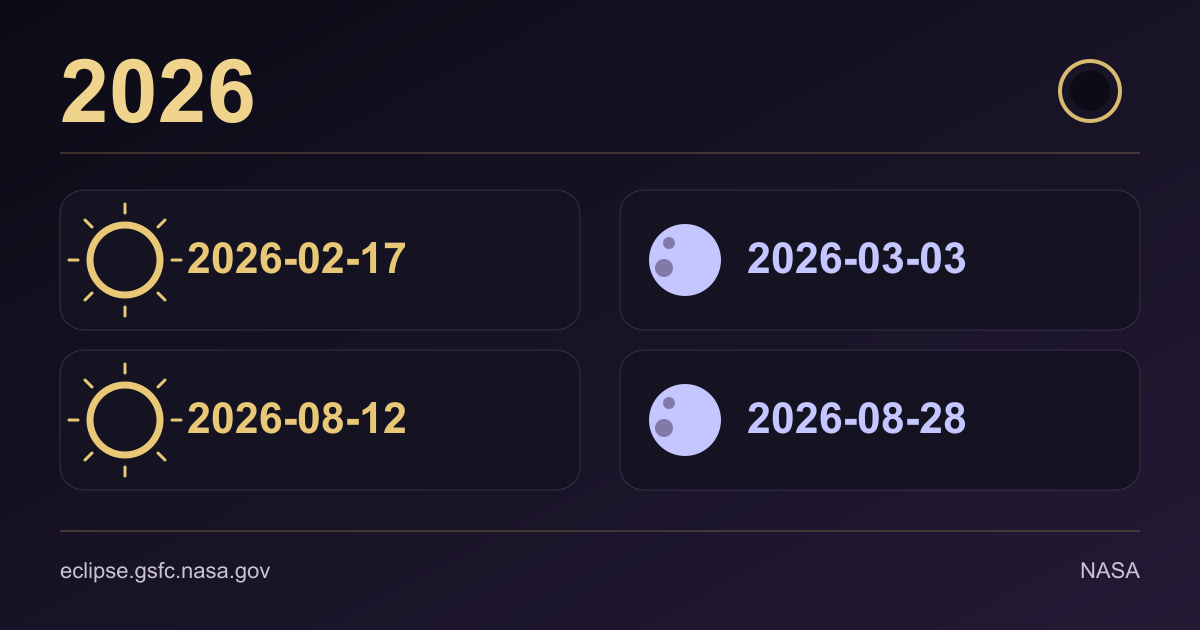
For astronomical event dates, use a complete catalog rather than a personal forecast. NASA lists February 17 and August 12 as the solar eclipses of 2026, and March 3 and August 28 as its lunar eclipses. In 2027, the solar entries are February 6 and August 2; the lunar entries are February 20, July 18 and August 17. Sources: the NASA solar catalog and NASA lunar catalog.
These are catalog reference dates; local calendar dates can differ. A night described locally as August 27 may correspond to the catalog’s August 28 event. The catalog’s maximum-eclipse tables use a stated time scale; no local clock or UTC conversion is inferred here. The earlier February 17, 2027 solar-eclipse entry was incorrect. A node’s sign alone also does not establish the zodiac position of an eclipse.
An astronomical date does not establish personal significance, a healing deadline or a financial opportunity. This article provides no viewing instructions. For solar observation, consult NASA eclipse safety guidance.
A solar-sign overlay counts the Sun’s sign as the first position. It can supply an illustrative set of topics, but it is not your natal house calculation. An actual chart needs a date, time reference, location and identified conventions. In Whole Sign houses, the first house is the sign containing the Ascendant; that sign need not be your Sun sign.
You can explore the birth-chart calculator while keeping uncertain inputs visible. Read about the Ascendant and the natal-chart distinction before treating a displayed house as established. The ephemeris references above explain calculations, not certification of this app’s output or validation of an AI interpretation.
AI-assisted editorial content. Astrological symbolism is optional reflection, not medical, financial, legal or mental-health advice.