The Aquarius–Leo node axis does not assign Gemini readers a transformation, diagnosis or fate. This guide separates the calculated reference from an optional symbolic reading. Its focus is learning and sharing information, with questions that you can accept, adapt or leave aside.
The lunar nodes are the intersections of the Moon’s orbital plane with the ecliptic. They are calculated points, not planets. The ascending or North Node and descending or South Node form opposite ends of an axis. Their astrological meanings are interpretations added to that geometry.
The node convention matters. The Astrodienst daily ephemerides for 2026 show the true North Node moving from tropical Pisces into Aquarius in late July; the mean node reaches that boundary in August. The 2028 ephemerides place the next transition toward Capricorn in March, with different dates for the two conventions. These daily tables do not establish an exact ingress clock. They do not support the earlier article’s January 2028 endpoint.
True and mean node calculations differ; the Swiss Ephemeris technical documentation explains the distinction. A chart should identify its convention and zodiac reference. The South Node is opposite the North Node, so a tropical Aquarius position corresponds to a Leo position at the other end. That axis does not identify an individual’s purpose or forecast an outcome.
Gemini is traditionally linked with communication and curiosity. These are symbolic themes, not measured traits of every Gemini reader. The lunar nodes do not establish that you have already mastered knowledge in a previous life or that your task is to teach a collective.
If you want to learn something, begin with an actual question. What do you need to understand, and where would reliable evidence come from? A course, book or conversation can be useful, but a confident speaker is not automatically a dependable source. Check who produced the material, what evidence supports it and whether uncertainty is acknowledged.
When sharing a claim, distinguish your experience from a general finding. Saying that a practice helped you does not prove it will help everyone. An AI summary can also omit a condition or misstate a date. Follow important statements back to the original source. Choosing not to teach something you have not checked is a responsible choice, not a failure to follow a nodal mission.
A solar-sign overlay beginning with Gemini places Aquarius ninth and Leo third. Astrological traditions connect these positions with broader study and everyday communication. This is an illustrative numbering system, not a finding about where the nodes fall in your natal houses.
An optional reflection is to compare how you communicate in different settings. Does a short message need more context? Would a complex topic benefit from a longer discussion? Ask the recipient what they need instead of assigning a communication style from a chart. Different preferences can be negotiated.
For a larger learning project, define a practical stopping point: read a primary document, write down unresolved questions, or ask someone qualified to explain a specific issue. You do not need to turn every interest into a qualification or a public role. Travel and education also have costs and access requirements. Evaluate those conditions directly; an eclipse is not a reason to ignore them or a guarantee that a new viewpoint will improve your life.
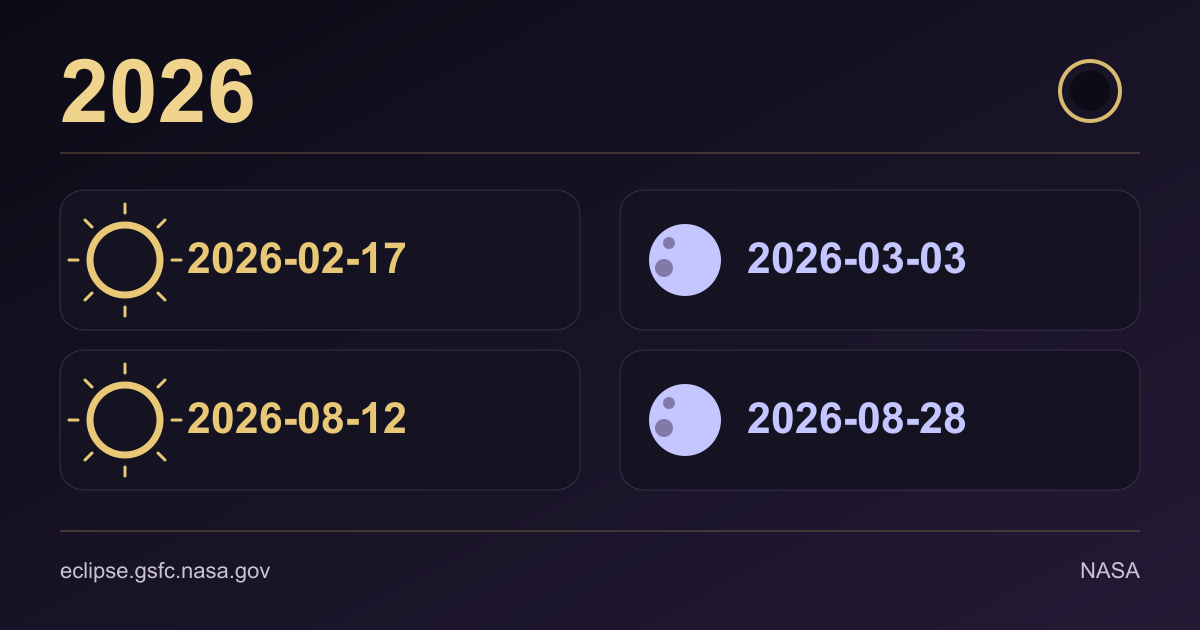
For astronomical event dates, use a complete catalog rather than a personal forecast. NASA lists February 17 and August 12 as the solar eclipses of 2026, and March 3 and August 28 as its lunar eclipses. In 2027, the solar entries are February 6 and August 2; the lunar entries are February 20, July 18 and August 17. Sources: the NASA solar catalog and NASA lunar catalog.
These are catalog reference dates; local calendar dates can differ. A night described locally as August 27 may correspond to the catalog’s August 28 event. The catalog’s maximum-eclipse tables use a stated time scale; no local clock or UTC conversion is inferred here. The earlier February 17, 2027 solar-eclipse entry was incorrect. A node’s sign alone also does not establish the zodiac position of an eclipse.
An astronomical date does not establish personal significance, a healing deadline or a financial opportunity. This article provides no viewing instructions. For solar observation, consult NASA eclipse safety guidance.
A solar-sign overlay counts the Sun’s sign as the first position. It can supply an illustrative set of topics, but it is not your natal house calculation. An actual chart needs a date, time reference, location and identified conventions. In Whole Sign houses, the first house is the sign containing the Ascendant; that sign need not be your Sun sign.
You can explore the birth-chart calculator while keeping uncertain inputs visible. Read about the Ascendant and the natal-chart distinction before treating a displayed house as established. The ephemeris references above explain calculations, not certification of this app’s output or validation of an AI interpretation.
AI-assisted editorial content. Astrological symbolism is optional reflection, not medical, financial, legal or mental-health advice.